New paper in Communications Materials: Comparing correlation in infinite-layer cuprates and nickelates
07 May 2026
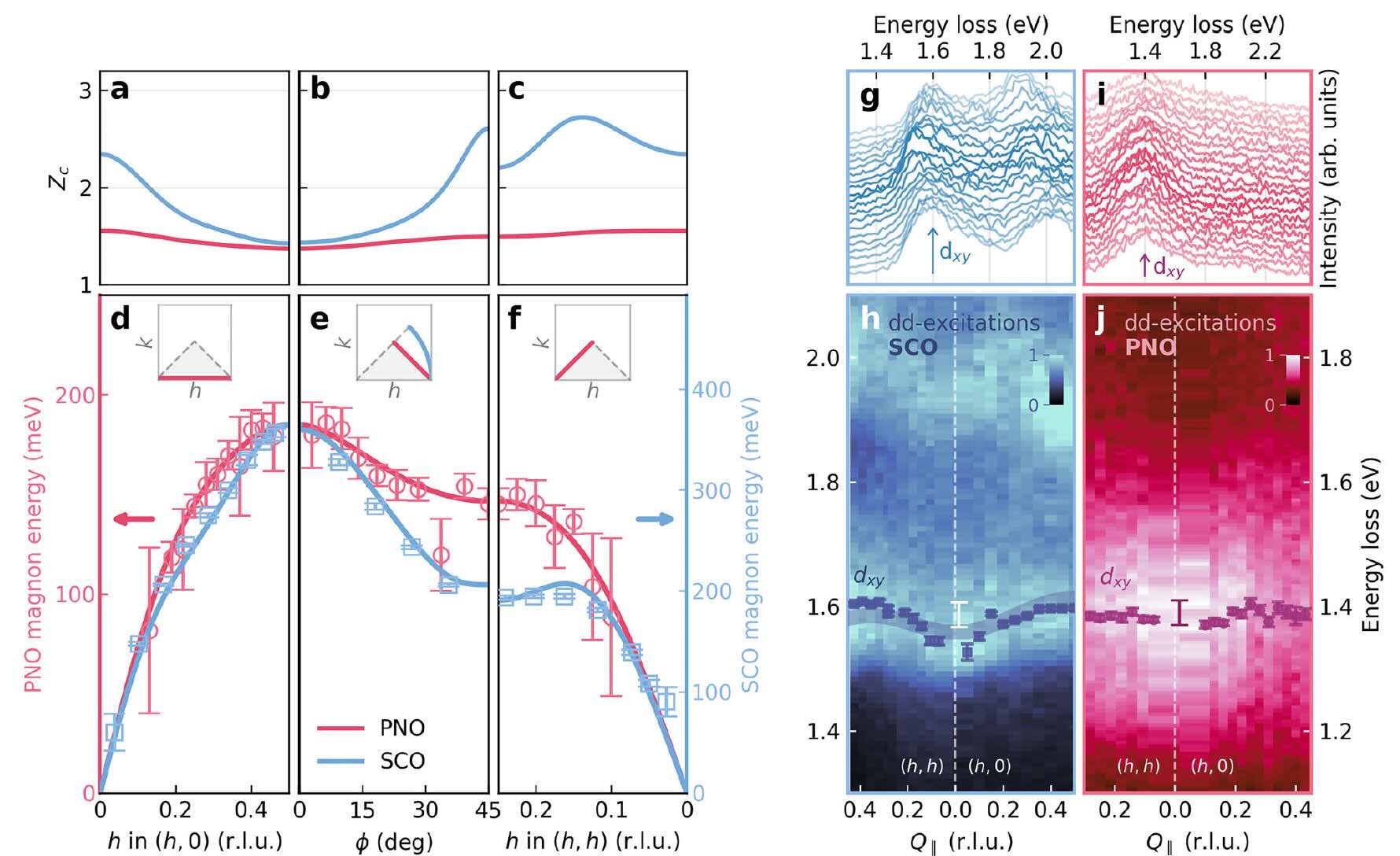
A central question in the study of infinite-layer nickelates is their relationship to cuprates. In particular, understanding how electron correlations differ between infinite-layer nickelates and cuprates is essential for identifying the microscopic ingredients that control their magnetic and electronic ground states.
To address this question, we performed resonant inelastic x-ray scattering (RIXS) measurements on infinite-layer PrNiO2 and compared its collective excitations with those of the isostructural cuprate SrCuO2. Our experiments reveal dispersive magnetic excitations in PrNiO2 with a magnon bandwidth of approximately 180 meV, about half that observed in SrCuO2, indicating a substantially reduced magnetic energy scale in the nickelate. By analyzing the magnon dispersion within a Hubbard-Heisenberg framework, we find that although the effective Coulomb interaction U is lower in PrNiO2 than in SrCuO2, the reduced hopping amplitude leads to a larger correlation ratio U/t in PrNiO2.
These results demonstrate that PrNiO2 is more strongly correlated than its infinite-layer cuprate counterpart, despite having a smaller absolute Coulomb interaction. Our work provides an experimental route to quantify correlation strength from spin excitations and offers new insights into the distinct magnetic and electronic properties of infinite-layer nickelates and cuprates.
This work has been published in Communications Materials (X. Hong, Y. Wu, Q. Wang✉, J. Chang et al. Impact of electron correlations on infinite-layer cuprates and nickelates. https://doi.org/10.1038/s43246-026-01175-0). We are thankful to all collaborators.